Collagen
Most collagen powders do nothing. The reason is on the back of the tub.
The trials that produced measurable results used specific gram doses. Here is how to check whether your tub delivers one.
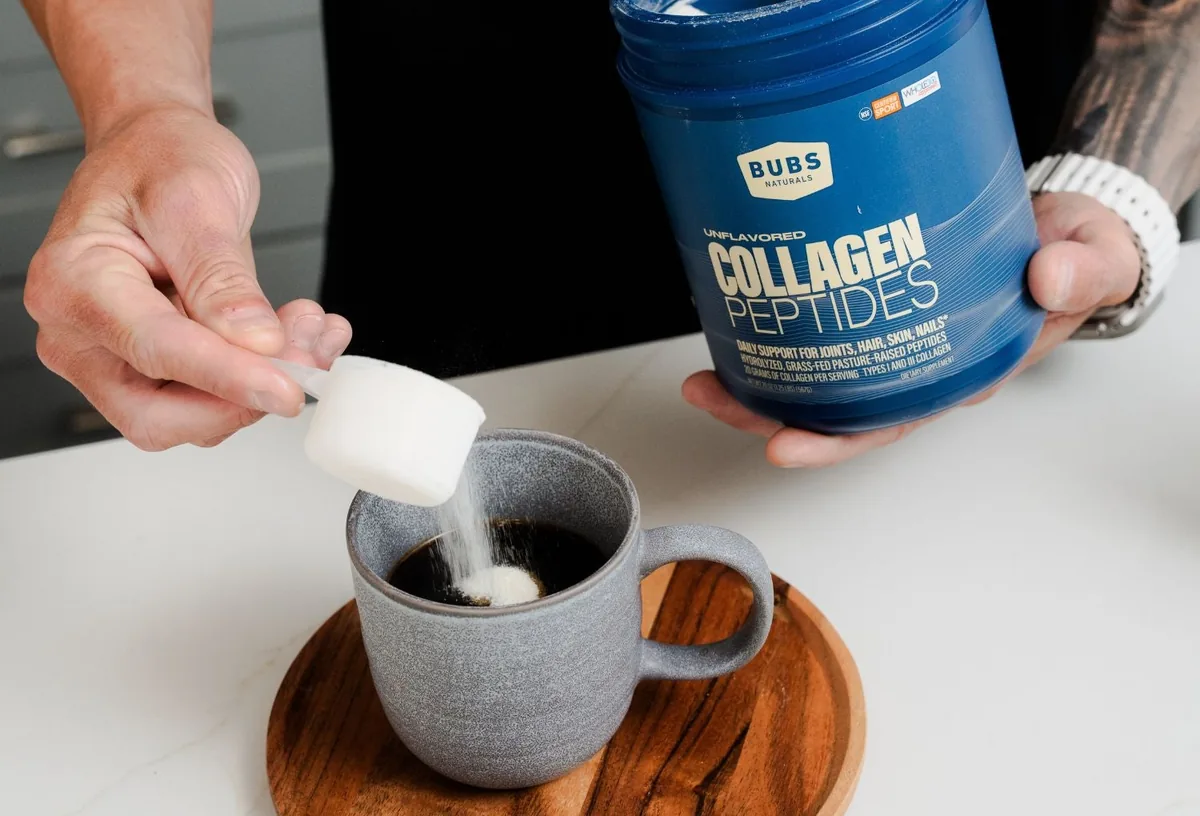
There is a version of this story that almost everyone who has ever bought collagen has lived. You picked up a tub because a friend swore by it. You took it most mornings for six or eight weeks. Nothing happened. You finished the tub out of stubbornness, did not reorder, and filed collagen under things that do not work.
That conclusion may be right. It may also be the wrong conclusion drawn from a fair experiment, because the experiment was never really run. The trials that produced measurable results all have one thing in common, and it is boring: they gave people a specific number of grams, every day, for two to six months. If your tub never delivered that number, you did not test collagen. You tested a tub.
What follows is the short version of what separates one from the other, and a test you can run on any container in about thirty seconds.
Two experiments
The one most people have run at home, and the one the published studies ran.
What you did
Not a test of collagen
What the trials did
A test of collagen
Section 01
The number the trials were built on
Collagen supplementation has a real clinical literature. It is not enormous, the studies are mostly small, and the same collagen research group has an author on three of the four trials below, which is worth knowing before you read them. But the published trials are specific about one thing, and that specificity is the useful part: they tell you how much people took.
Daily dose used
Four published randomized, placebo-controlled trials of collagen peptides, and the daily amount each one gave its participants.
Sources, in order: Proksch et al., Skin Pharmacology and Physiology 2014;27(1):47-55. Zdzieblik et al., Applied Physiology, Nutrition and Metabolism 2017. Clark et al., Current Medical Research and Opinion 2008;24(5):1485-96. Zdzieblik et al., British Journal of Nutrition 2015. Abstracts published on PubMed.
Read the bars again and notice what is not there. Nothing under 2.5 grams. Nothing taken for three weeks. In the 2008 study at Penn State, 147 varsity and club athletes took 10 grams of collagen hydrolysate a day for 24 weeks, and six separate measures of joint pain improved significantly against placebo. In the 2015 study, 53 men with an average age of 72 trained three times a week for 12 weeks; the group taking 15 grams of collagen peptides gained more fat-free mass and more quadriceps strength than the group taking a placebo alongside the identical training.
None of that is a promise about you. It is a floor. It tells you the amount at which anyone has bothered to look for an effect, and it means a scoop delivering one or two grams inside a proprietary blend has never been tested for anything at all.

Section 02
Why the tub often refuses to tell you
Here is the part that annoys people when they learn it, and it is the honest answer to why nobody explains any of this on the front of a jar.
Federal labelling rules let a supplement declare a group of ingredients as a proprietary blend. Under 21 CFR 101.36(c), the ingredients inside that blend must be listed in descending order of predominance by weight, and the amount that must be printed is the total weight of the whole blend. The individual amounts are not required.
Two legal labels
Both of these panels comply with federal rules. Only one of them answers the question you are actually asking.
Supplement Facts
Listed in descending order by weight. The split between the four is not disclosed and does not have to be.
You cannot compute your dose
Supplement Facts
One dietary ingredient, one number. Nothing to apportion.
You can compute your dose
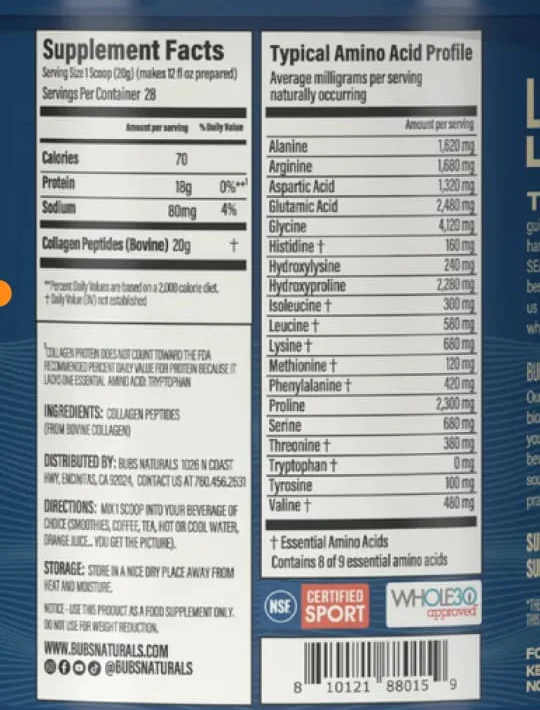
Left panel: an illustrative blend built to the pattern permitted by 21 CFR 101.36(c)(2) and (c)(3), not a copy of any specific product. Right panel: the published Supplement Facts of BUBS Naturals Collagen Peptides, 20 oz tub.
Five thousand milligrams is five grams, which sounds like it clears the bar. But it is five grams of four things, and if the eggshell membrane is doing most of the work by weight, the collagen you are chasing might be a gram. That is not a scandal and nobody is breaking a rule. It is simply a label that cannot answer the only question that matters.
The blend is not the villain. The missing number is. A single-ingredient panel is easy to read for exactly the same reason it is unglamorous: there is nothing to divide.
Section 03
And the number on the tub is not always the number in the tub
Assume the label does give you a clean figure. There is a second gap, and this one is not about wording. It is about whether the powder inside matches the panel outside.
NSF, the body behind the testing standards written for dietary supplements, explains why its certification program exists at all. It points, in its own words, to
"reports that suggest that some of these products do not actually contain the ingredients or quantities shown on the label, or are found to be adulterated in other ways."NSF, published at nsfsport.com, quoted verbatim.
That is why third-party certification exists at all, and why it is worth more than any wording on a carton. NSF's Certified for Sport program, which it says is the only independent third-party certification program recognized by the United States Anti-Doping Agency, verifies four things:
- The product contains none of 290 substances banned by major athletic organizations.
- The contents of the supplement actually match what is printed on the label.
- There are no unsafe levels of contaminants in the tested product.
- It is made in a GMP-certified facility, audited annually or twice yearly.
The second line is the one to remember. It is the only mechanism in the entire category that puts an outsider between a marketing department and a scoop. The list of certified products is public and searchable at nsfsport.com, which means you can check a tub before you buy it rather than after.
Section 04
Hydrolyzed is not a marketing word
Collagen in its natural state is a long triple-helix protein, the structural cable in skin, tendon and bone. It is not soluble in your coffee and it is not built to be swallowed as a powder. Hydrolysis is the industrial step that cuts those cables into short fragments, typically two or three amino acids long. Those fragments are what a supplement is actually made of, and the word for them is peptides.
What hydrolysis does
The same protein, before and after the step that makes it usable as a powder.
Blood measurement: Shigemura et al., "A Pilot Study for the Detection of Cyclic Prolyl-Hydroxyproline (Pro-Hyp) in Human Blood after Ingestion of Collagen Hydrolysate," Nutrients 2018. Levels of hydroxyproline-containing peptides rose after ingestion and peaked around two hours. Appearance in blood is not by itself proof of an effect on a joint or on skin.
This matters twice. It matters biologically, because those short fragments are what has been measured in human blood after a dose. And it matters practically, because hydrolyzed powder is the only kind that vanishes into hot coffee instead of sitting on top of it in a raft.
Which brings us to the variable that decides more outcomes than any of the above.
Section 05
The variable no label carries: whether you will still be drinking it in week twelve
Go back to the chart. Eight weeks. Twelve weeks. Twenty-four weeks. Every one of those results was produced by people who took the stuff every single day for months.
How long each trial ran
Before anybody measured anything at all.
Proksch 2014
Zdzieblik 2017
Zdzieblik 2015
Clark 2008
For scale: a 28-serving tub taken once a day lasts four weeks. The shortest trial on this row is two tubs. The longest is six.
There is no supplement in the world whose active ingredient survives being left at the back of a cupboard. And the reason tubs end up at the back of cupboards is almost never a considered decision about efficacy. It is that the powder clumped. It tasted like something. It needed a blender and a rinse, at 6.40 in the morning, when the whole appeal was that it went in the coffee.
You can watch this happen in the public record. Read the written reviews on a collagen product and count what people actually talk about. Below is that count for one product, and the ranking is not what a marketing plan would predict.
What reviewers bring up
The 803 written reviews of BUBS Naturals Collagen Peptides published on bubsnaturals.com, sorted by the topic each one mentions. One review can mention several.
Counted on August 14, 2026 across the 803 reviews of Collagen Peptides carrying written text, published through the brand's public review platform. Topics assigned by keyword; percentages are of the 803.
Twice as many people talk about how it mixes as talk about what it did to their skin, and seven times as many as talk about their joints. That is not a sign that the product does nothing. It is a sign that the daily friction is the thing people notice, and daily friction is precisely what decides whether anyone reaches week twelve.
"i appreciate how clean it is and that it doesn't change the flavor of my coffee. most other brands that claim to be flavorless actually aren't, and it's often an unpleasant taste. well done and thank you!"Verified buyer, five stars, published on bubsnaturals.com, July 3, 2026. Quoted exactly as written.
Section 06
The label test: five questions, thirty seconds
Turn the tub around. You are looking for five answers, and you can get all of them before the kettle boils.
-
Is there a number of grams of collagen, on its own line?
Not "proprietary blend", not a list of five collagen types with one shared total. One ingredient, one weight.
If you have to do algebra, the label has already answered you. -
Is that number in the range anybody has studied?
The published trials sit between 2.5 and 15 grams a day. A scoop that lands under a gram of actual collagen is outside the entire literature.
Below 2.5 g, there is nothing to compare it to. -
Does it say hydrolyzed, or peptides?
Those two words mean the protein has been cut into the short fragments that dissolve and that have been measured in blood after a dose. "Collagen protein" on its own does not tell you.
Hydrolyzed, or peptides, or keep looking. -
Does anyone outside the company check the label?
A third-party mark such as NSF Certified for Sport means an outside laboratory verified that the contents match the panel. Look it up in the public database rather than trusting the logo.
Searchable at nsfsport.com, in under a minute. -
Will you actually drink it every day for three months?
The least scientific question on the list and the one that decides the outcome. Unflavored, dissolves in a hot drink, no blender: those are not luxuries, they are the delivery mechanism for the dose.
If it needs a ritual, it will not survive February.
Section 07
Running the test on one tub
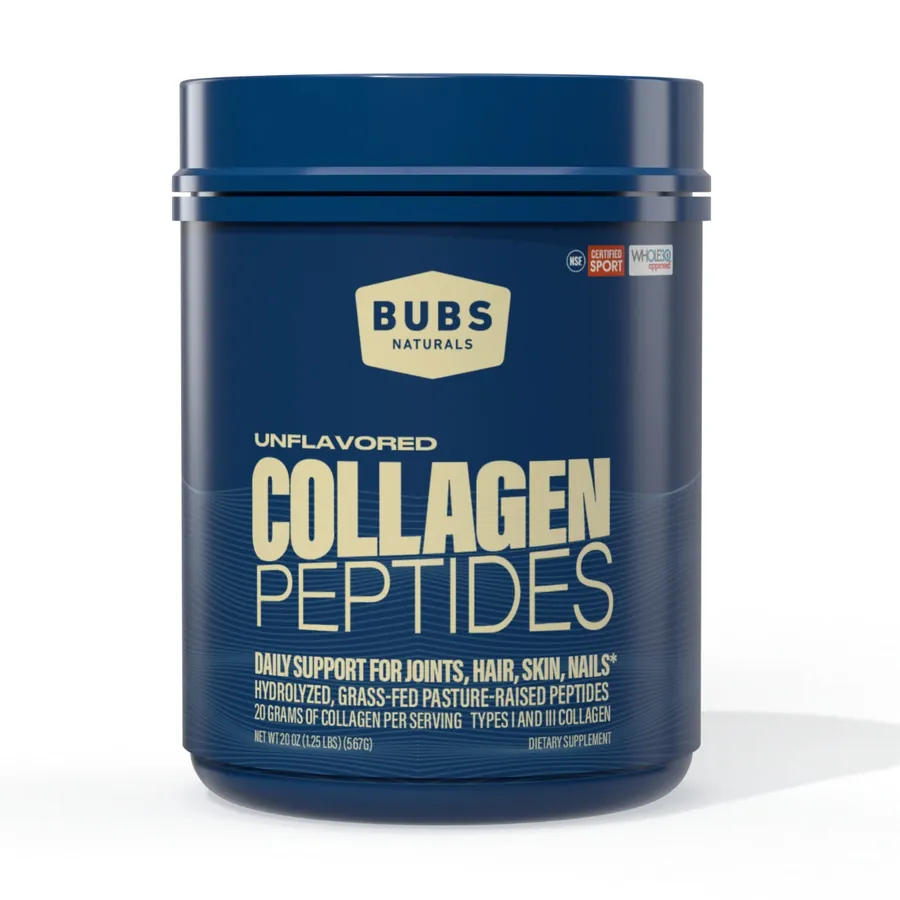
A worked example is more useful than a principle, so here is the test applied to a product that happens to publish everything it needs to publish: the collagen peptides made by BUBS Naturals, a supplement company in Encinitas, California. Every figure below is taken from the label and the product page as published on August 14, 2026.
The five questions, answered off the label
GRAMS ON THEIR OWN LINE
Collagen Peptides (Bovine), 20 g per 20 g scoop. The panel lists one dietary ingredient and one weight.
INSIDE THE STUDIED RANGE
20 g sits above the 15 g used in the largest of the four trials above, so a single scoop clears every dose on that chart.
HYDROLYZED
The front of the tub reads hydrolyzed, grass-fed pasture-raised peptides, types I and III. The ingredient line is collagen peptides from bovine collagen, and nothing else.
CHECKED BY AN OUTSIDER
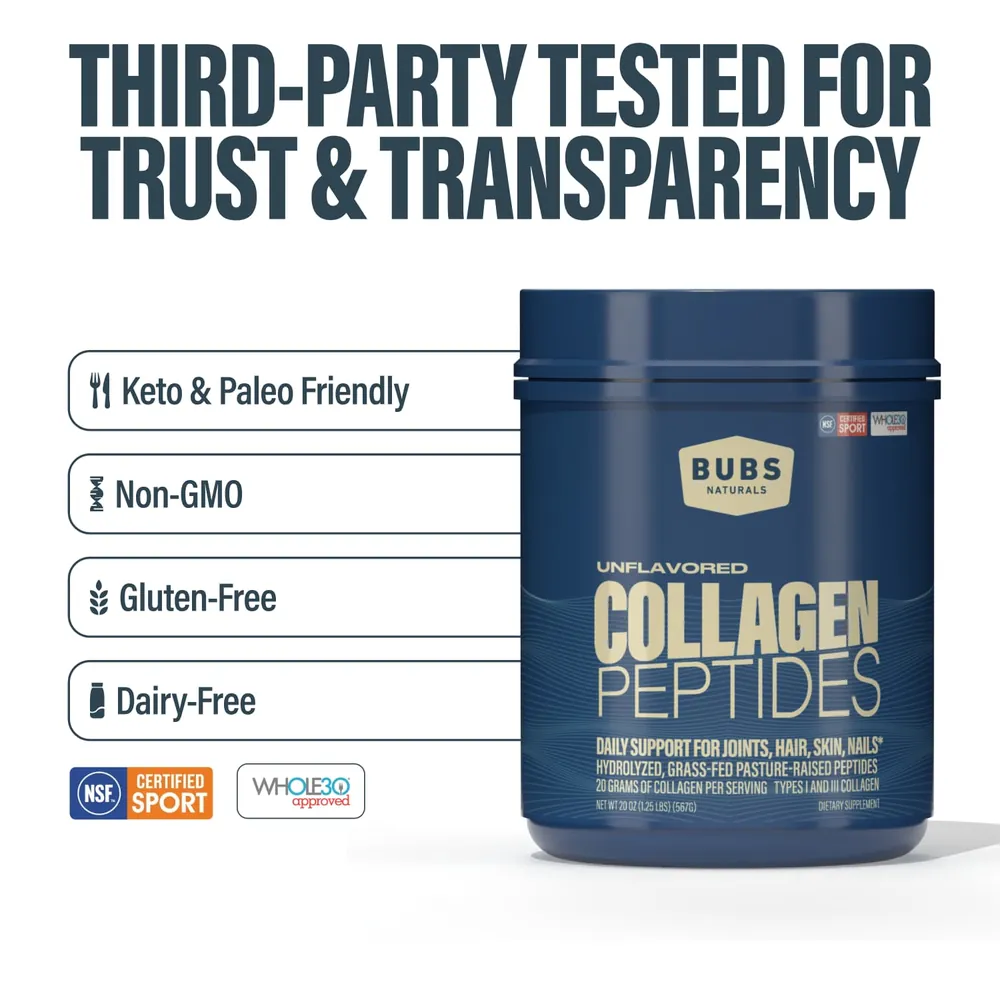
NSF Certified for Sport and Whole30 Approved. "Bubs Naturals Collagen Peptides" appears in the public NSF certified-product listing, so the mark can be verified without taking the carton's word for it.
SURVIVES A TUESDAY
Unflavored and heat tolerant. The directions say to mix one scoop into coffee, tea, hot or cool water, smoothies or juice, with no equipment named.
Two details on that panel deserve a straight answer rather than a bullet point, because both look like discrepancies until you read the small print.
Why 20 grams of collagen shows up as 18 grams of protein
The panel declares 20 g of collagen peptides and 18 g of protein in the same 20 g scoop. That is not a rounding trick. Protein on a nutrition panel is calculated from nitrogen content, and collagen's amino acid mix does not convert one for one. The label also carries the honest footnote that most brands would rather leave off: collagen protein does not count toward the FDA recommended daily value for protein because it lacks tryptophan, one of the nine essential amino acids.
Their own amino acid table says so in the plainest possible way. Tryptophan: 0 mg.
Amino acid profile
Milligrams per 20 g serving, as published on the label. The six largest, plus the one that is absent.
Typical amino acid profile printed on the 20 oz tub of BUBS Naturals Collagen Peptides. Glycine, proline and hydroxyproline are the residues that characterize collagen; hydroxyproline is the marker used to track collagen peptides in blood. The label states the product contains 8 of the 9 essential amino acids.
Publishing a zero is a small thing that tells you something. A brand willing to print the one number that undercuts a protein claim is a brand that expects you to read the back.
What a tested dose costs per morning
The other number nobody prints is the only one your budget cares about, and it takes one division. The 20 oz tub is $47.00 and the panel declares 28 servings.
One dollar and sixty-eight cents a morning for a dose above every trial on the chart. Whether that is worth it is your call, but it is at least a call you can now make with numbers instead of adjectives. They also sell a 10 oz tub at $27.00 and a 20-count travel carton at $37.00.
Section 08
Where this does not apply
An article that only argues one way is an advertisement with footnotes, so here is the other side, and some of it comes from the brand's own review page.
- It is not a drug and it does not treat anything. The trials above measured elasticity, pain scores and strength in specific populations over specific windows. None of that entitles anyone to a promise about your knee.
- It is bovine. If you do not eat beef, this whole category is closed to you and no amount of sourcing language changes that.
- It is not a complete protein. Their own label says it: no tryptophan, so it does not replace the protein in your diet. Treat it as an addition, not a substitution.
- Plenty of people notice nothing. That is true of every supplement with modest effect sizes, and it is visible in their own published reviews if you scroll far enough.
Two reviews the brand chose to leave up
"dissolve well in liquids. Did not notice a difference between Bubs and the once I used previously except Bubs is more expensive"
Verified buyer, four stars, July 22, 2026
"This is the only collagen that is truly flavorless. I buy it for the protein to put in my morning cup of coffee. My daughter and I both drink it. I have personally not seen improvement in my hair, nails, or joints. However, my daughter does think her nails are stronger because of it and her skin is glowing. She is 48 and I am 72."
Verified buyer, five stars, July 25, 2026
Both of those are on the public product page right now. A company that leaves them there is telling you something about the rest of the page.
Section 09
What the other reviewers say
Across the platform the product carries 3,811 ratings at an average of 4.89, with 99% saying they would recommend it. Four of the written ones, quoted as published:
"I've tried other collagen products. I prefer this one because it is micronized. It's completely neutral (no taste) It mixes well in my morning coffee."
★★★★★ Verified buyer · August 3, 2026
"Tried other brands, Bubs is the only one that works for my body. My knees and joints have never felt better. So much easier to get going every day now that Bubs is part of my routine."
★★★★★ Verified buyer · July 31, 2026
"At 55 years old, I have been fighting shoulder/joint pain for a long time now. Gave this stuff a try. My should pain is reduced, I specifically notice this when doing incline bench press when I go over 185 pounds. I am training a little harder, and the only thing I have changed is including Bubs Collagen Peptides in my supplement routine."
★★★★★ Verified buyer · July 17, 2026
"Our family would never use any other collagen product than Bub's. We enjoy a scoop in our coffee in the AM. My skin, hair and nails have never looked better. Researching where the collagen comes from, it is from one source and healthy! We have been using it for at least 10 years"
★★★★★ Verified buyer · August 8, 2026
Reviews reproduced verbatim, including original spelling, from the public product page on bubsnaturals.com, read August 14, 2026. Individual experiences are not evidence of a general effect.
Section 10
The part that has nothing to do with collagen
There is one more thing on this label that no test above can measure, and it would be strange to leave it out.
BUBS is short for Glen "BUB" Doherty, described on the company's own pages as a Navy SEAL and a hero who lived a life of selfless service. The brand was created by his best friend. It runs what it calls the 10% Rule: ten per cent of all profits go to charity. The About page currently reports $220,345 donated to the Glen Doherty Foundation.

"Glen and I grew up together and shared more adventures than I would have thought possible. Along the way there were mountains climbed, trails biked, waves surfed, powder harvested, laughs to be had, life lessons learned and so much more. Those years were formative. Today we are honored to celebrate his legacy."Sean Lake, founder, published on bubsnaturals.com
None of that makes a powder work. A cause is not a clinical trial and it should never be the reason you swallow something. But you are going to buy collagen from somebody, at roughly the same price, and one of those purchases funds a foundation while the others fund a marketing budget. Once the label has answered the five questions, that stops being sentiment and starts being a tiebreaker.

In short
Four lines, and then go read a label
- The trials that found anything used 2.5 to 15 grams a day, for 8 to 24 weeks. Duration is part of the dose.
- A proprietary blend can legally hide how much collagen you are getting. A single-ingredient panel cannot.
- A third-party mark is the only outside check that the tub contains what the panel claims.
- The powder you will still be drinking in February beats the powder with the better story.
See the label for yourself
The full Supplement Facts panel, the amino acid profile, the certifications and the current price are all on the product page. Turn it around before you decide.
Read the BUBS Collagen Peptides label20 oz tub $47.00 · 10 oz tub $27.00 · 20-count travel pack $37.00
Prices and specifications as published on bubsnaturals.com on August 14, 2026.